Evaluating the People Playing Music 3D Shadow Box for Layered Paper Crafting
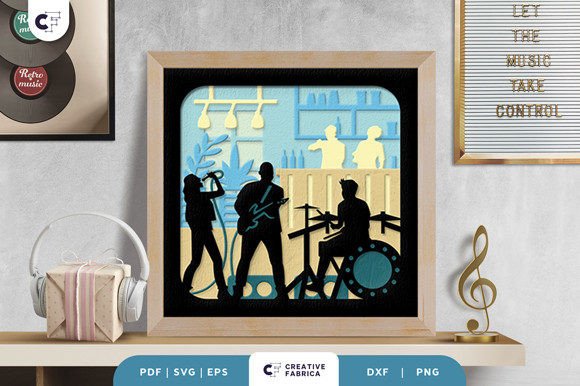
For crafters navigating the expansive world of paper art, selecting a project that balances aesthetic appeal with technical feasibility is often a challenge. The People Playing Music 3D Shadow Box represents a specific category of layered paper cutting templates designed to create depth and narrative through silhouette art. Unlike flat scrapbooking or standard card making, this format relies on the strategic stacking of multiple layers to generate a three-dimensional effect. This particular design features a square composition, measuring 20.32×20.32 cm, and consists of eight distinct layers. Understanding whether this template fits your current skill level, equipment, and decorative goals requires a close look at its structural requirements, material compatibility, and potential applications compared to other crafting approaches.
Structural Complexity and Layer Management
The defining characteristic of the People Playing Music 3D Shadow Box is its eight-layer architecture. In the realm of papercrafting, the number of layers directly correlates to the perceived depth of the final piece. Projects with fewer than five layers often appear somewhat flat, lacking the immersive quality that defines true shadow box art. Conversely, designs exceeding ten layers can become prohibitively complex for beginners, requiring precise spacing and significant structural support to prevent sagging or collapse.
With eight layers, this template occupies a "sweet spot" in terms of complexity. It offers sufficient depth to create a convincing illusion of distance between the musicians in the foreground and the background elements, yet it remains manageable for intermediate crafters. When comparing this to single-layer die cuts or simple vinyl decals, the difference in labor and material usage is substantial. Each layer must be cut, weeded (if using vinyl, though cardstock is preferred here), and adhered with specific spacing. This necessitates a decision regarding the spacing method: will you use foam adhesive squares, rolled paper tubes, or wooden spacers? The choice impacts not only the visual depth but also the stability of the finished product.
File Formats and Cutting Method Compatibility
A critical factor in evaluating any digital template is its compatibility with your existing tools. The People Playing Music 3D Shadow Box is distributed in a comprehensive suite of formats: SVG, PDF, EPS, PNG, and DXF. This versatility is a significant advantage over templates that offer only a single file type.
- SVG and DXF: These vector files are essential for users owning electronic cutting machines such as Silhouette Cameo or Cricut Explore/Maker. They allow the machine to read the cut lines precisely, ensuring that intricate details like instrument strings or facial profiles are rendered accurately. A key benefit of SVG files is scalability; while the default size is 20.32×20.32 cm, users can resize the design to fit different frame dimensions. However, it is imperative to maintain the aspect ratio during resizing to prevent distortion of the musical figures.
- PDF and EPS: These formats cater to professional printing services or users who prefer to print the template and cut manually. PDFs are universally accessible, making them ideal for those without specialized software.
- PNG: While primarily a raster image format, high-resolution PNGs can be used for tracing or as visual references during manual cutting.
For crafters without access to digital cutting machines, the availability of these formats ensures the project remains accessible via traditional methods. Using an art knife and scissors requires a higher degree of patience and steady hand control, particularly for the inner details of the eight layers. When weighing the effort of manual cutting against machine cutting, one must consider the time investment. A machine might complete all eight layers in under thirty minutes, whereas manual cutting could take several hours, depending on dexterity.
Material Selection and Structural Integrity
The success of a multi-layer shadow box hinges heavily on the weight and stiffness of the paper used. The template documentation recommends Encore Cardstock 80 lb cover (216 gsm). This specification is not arbitrary; it is a functional requirement for this type of project. Lighter cardstocks, such as 65 lb cover, may buckle under the weight of upper layers or fail to hold their shape when spaced apart, leading to a drooping final product. Heavier stocks, while sturdy, can be difficult to cut cleanly, especially with manual tools or lower-force cutting machines.
When comparing this requirement to other paper crafts, the tolerance for error is lower. In card making, a slight tear or uneven edge might be hidden by embellishments. In a backlit shadow box, however, light reveals every imperfection. Therefore, investing in high-quality, consistent cardstock is a necessary tradeoff. Crafters accustomed to using textured or handmade papers should note that uniform thickness is crucial for even lighting and clean assembly. If the goal is a painted finish, the 80 lb weight provides enough surface durability to handle light washes without warping excessively.
Illumination Options: Framed Art vs. Light Box
One of the most versatile aspects of the People Playing Music 3D Shadow Box is its dual potential as either a standard framed wall decoration or an illuminated light box. This distinction fundamentally changes the viewer's experience and the assembly process.
Standard Framed Display: When used as a static wall piece, the focus is on the interplay of shadows created by ambient room lighting. The depth of the eight layers creates natural shading, giving the musicians a sculptural presence. This approach is generally more forgiving regarding assembly gaps, as strong backlighting will not expose uneven spacing. It is a suitable choice for living rooms or offices where a subtle, sophisticated accent is desired.
Illuminated Light Box: Adding LED strips between the layers transforms the project into a glowing centerpiece. This option highlights the negative space and silhouettes, creating a dramatic, high-contrast effect. However, this introduces additional logistical considerations. Crafters must source low-heat LED strips, plan wire routing, and potentially modify the frame to accommodate a power source. The paper choice becomes even more critical here; lighter colors will transmit more light, while darker cardstocks will enhance the silhouette effect but reduce overall brightness. For those comparing this to pre-made light boxes, the DIY route offers customization in color temperature and layer spacing but demands a higher level of technical assembly.
Decision Factors and Best-Fit Scenarios
Determining whether the People Playing Music 3D Shadow Box is the right project involves assessing your specific constraints and objectives. This template is an excellent fit for individuals seeking a meaningful, handmade gift for music enthusiasts, families, or friends. The thematic element of people playing music adds a narrative layer that generic geometric patterns lack, making it emotionally resonant.
However, there are scenarios where alternative options might be preferable. If you are a complete novice to paper crafting, starting with a three or four-layer design might build the necessary confidence and technique before tackling an eight-layer composition. Similarly, if you are working under a strict deadline, the assembly time for eight layers—plus drying time for glue or double-sided tape—may be prohibitive compared to simpler decoupage projects.
Furthermore, consider the display environment. If the intended location lacks access to power outlets, the light box variation is not viable unless battery-operated LEDs are used, which adds bulk to the frame. In such cases, relying on natural shadow play is the more practical route. It is also worth noting that while the SVG files allow for resizing, significantly enlarging the design beyond the original 20.32 cm square may require sourcing larger frames and wider cardstock, which can increase costs and complicate the search for materials.
Final Considerations for Execution
Executing this project successfully requires attention to detail during the assembly phase. Whether using glue or double-sided tape, consistency in adhesive application ensures that the layers remain parallel. Warped layers can disrupt the visual flow and, in a lit box, create distracting hotspots or dark patches. Additionally, crafters should be aware that the final product color may vary slightly from preview images due to lighting conditions and the specific hue of the cardstock chosen. This variability is inherent to physical media and should be viewed as part of the custom nature of the craft rather than a defect.
In summary, the People Playing Music 3D Shadow Box offers a robust platform for exploring depth, light, and narrative in paper art. Its eight-layer structure provides a substantial challenge that yields impressive results, bridging the gap between hobbyist crafting and professional-looking decor. By carefully selecting materials, choosing the appropriate cutting method, and deciding on the illumination strategy, crafters can tailor this template to meet a wide range of aesthetic and functional needs. Whether displayed as a subtle shadow play or a glowing tribute to music, the project stands as a testament to the versatility of layered paper design.