Create a Stunning Panda Shadow Box 3D Today
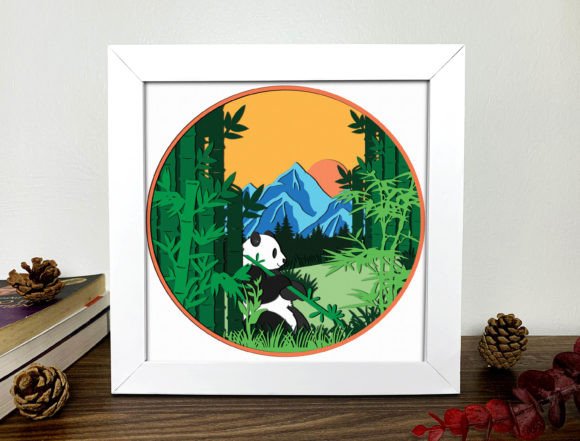
There is something uniquely satisfying about watching a flat sheet of paper transform into a scene with depth, texture, and life. The Panda Shadow Box 3D project captures this magic perfectly, offering a delightful blend of whimsy and technical precision that appeals to crafters of all skill levels. Whether you are a seasoned professional looking to expand your product line or a beginner eager to try your first layered paper cut, this design provides an accessible yet impressive result. At its core, this project is about layering. By stacking twenty-four distinct layers of paper, you create a illusion of three-dimensional space that draws the eye inward, turning a simple image of a panda into a captivating focal point for any room.
The appeal of this specific design lies in its versatility and the creative freedom it grants the maker. While the structural integrity of the shadow box comes from the precise digital files, the aesthetic outcome is entirely up to you. You can use paper of different colors to cut products, depending on their preferences. This means no two finished pieces need to look exactly alike. One creator might choose soft pastels and cream tones for a nursery setting, while another might opt for bold blacks, whites, and vibrant greens to mimic a natural bamboo forest. This adaptability makes the Panda Shadow Box 3D an excellent choice for personalized gifts, home decor, or even small-batch commercial sales where customization is a key selling point.
Why Layered Paper Cutting Captivates Creators
Layered paper cutting, often called papercutting or shadow boxing, has surged in popularity because it bridges the gap between traditional handcrafts and modern digital fabrication. The Panda Shadow Box 3D exemplifies this trend. It allows users to achieve a level of intricacy that would be nearly impossible to cut by hand consistently, especially when dealing with twenty-four separate layers. Each layer adds a slight elevation, creating shadows and highlights that change as light hits the frame from different angles. This dynamic quality gives the artwork a living feel, making it far more engaging than a standard flat print or painting.
For those who own machines like the Cricut Maker 3, this project is a dream come true. The machine's ability to handle fine details ensures that every ear, leaf, and bamboo stalk is cut with pristine accuracy. However, you do not need to be locked into a single ecosystem to enjoy this craft. The file received by the buyer is compatible with all cutters on the market. Whether you use a Silhouette, a Brother ScanNCut, or a generic desktop cutter, the provided formats ensure seamless integration into your workflow. This universal compatibility removes barriers to entry, allowing educators, hobbyists, and entrepreneurs to start creating immediately without worrying about software conversion errors or incompatible file types.
Practical Applications and Creative Uses
The utility of the Panda Shadow Box 3D extends far beyond hanging a picture on a wall. Its compact dimensions of 20x20cm (7.8x7.8in) make it incredibly versatile for various contexts. For parents and educators, this project serves as a fantastic STEM activity. Assembling twenty-four layers teaches children about sequencing, spatial awareness, and patience. It can be used in classrooms to discuss wildlife conservation, with the panda serving as a gentle ambassador for endangered species. Students can participate in the coloring or layer selection process, fostering a sense of ownership and pride in the final display.
From a business perspective, small business owners and freelancers can leverage this design to create high-margin products. Because the raw materials—paper and glue—are relatively inexpensive, the primary value lies in the assembly and the digital design itself. Entrepreneurs can sell completed shadow boxes at local craft fairs, on Etsy, or through social media channels. The ability to customize colors allows for "made-to-order" services, where clients request specific color schemes to match their interior decor. Additionally, marketers and bloggers can use these visually striking pieces as props for photography, adding depth and interest to flat-lay images or background settings for video content.
Even for casual users and hobbyists, the process offers a therapeutic benefit. The repetitive nature of weeding excess paper, aligning layers, and adhering them together can be meditative. It provides a tangible break from screen time, resulting in a physical object that brings joy. Whether placed on a bookshelf, used as a centerpiece for a baby shower, or gifted to a friend who loves animals, the Panda Shadow Box 3D carries a personal touch that mass-produced decor simply cannot replicate.
Understanding the Technical Specifications
To successfully bring this project to life, understanding the materials and files involved is crucial. The design is optimized for standard cardstock, which provides enough rigidity to hold its shape between layers without buckling. With 24 layers, the final depth of the artwork is significant, creating a pronounced tunnel effect. When selecting your paper, consider the weight; typically, 65lb to 80lb cardstock works best for most cutting machines, ensuring clean cuts without tearing delicate connections.
The digital package you receive is comprehensive, designed to support a wide range of workflows. You will receive 1 SVG, 1 DXF, 1 PDF, and 1 EPS file. The SVG and DXF files are ideal for cutting machines, containing the vector paths necessary for precise blade movement. The PDF is perfect for those who might want to print a reference guide or test the scale before cutting into expensive cardstock. The EPS file caters to professional graphic designers who may wish to modify the vector paths in software like Adobe Illustrator before sending them to a cutter. This multi-format approach ensures that regardless of your preferred tools or skill level, you have the right file for the job.
Important Considerations Before You Start
Before diving into your first Panda Shadow Box 3D, there are a few practical things to keep in mind to ensure the best results. First, patience is key. Assembling twenty-four layers requires careful alignment. Rushing this process can lead to crooked layers that disrupt the 3D illusion. Using a lightbox or a window can help you see through the layers to align them perfectly before applying adhesive. Second, think about your framing. Since the project builds outward from the base, you will need a shadow box frame with enough depth to accommodate the stacked paper without crushing the top layer against the glass. A depth of at least one inch is usually recommended for projects of this magnitude.
Color theory also plays a vital role. While you have the freedom to choose any palette, remember that contrast drives visibility. If you choose papers that are too similar in shade, the individual layers may blend together, losing the definition that makes the 3D effect work. Experiment with gradient effects, moving from dark shades in the back to lighter shades in the front, or vice versa, to enhance the perception of depth. Finally, consider the environment where the piece will live. Direct sunlight can fade paper over time, so if the shadow box is destined for a sunny windowsill, consider using archival-quality paper or UV-protective glass in your frame.
In summary, the Panda Shadow Box 3D is more than just a craft kit; it is a gateway to exploring the artistic potential of layered paper. It combines the precision of modern cutting technology with the timeless charm of handmade art. Whether you are cutting with a Cricut Maker 3 or another device, using the provided universal files, the result is a customizable, engaging, and beautiful piece of art. By understanding the materials, respecting the layering process, and embracing your creative color choices, you can produce a stunning visual statement that resonates with viewers and brings a touch of nature-inspired elegance to any space.